


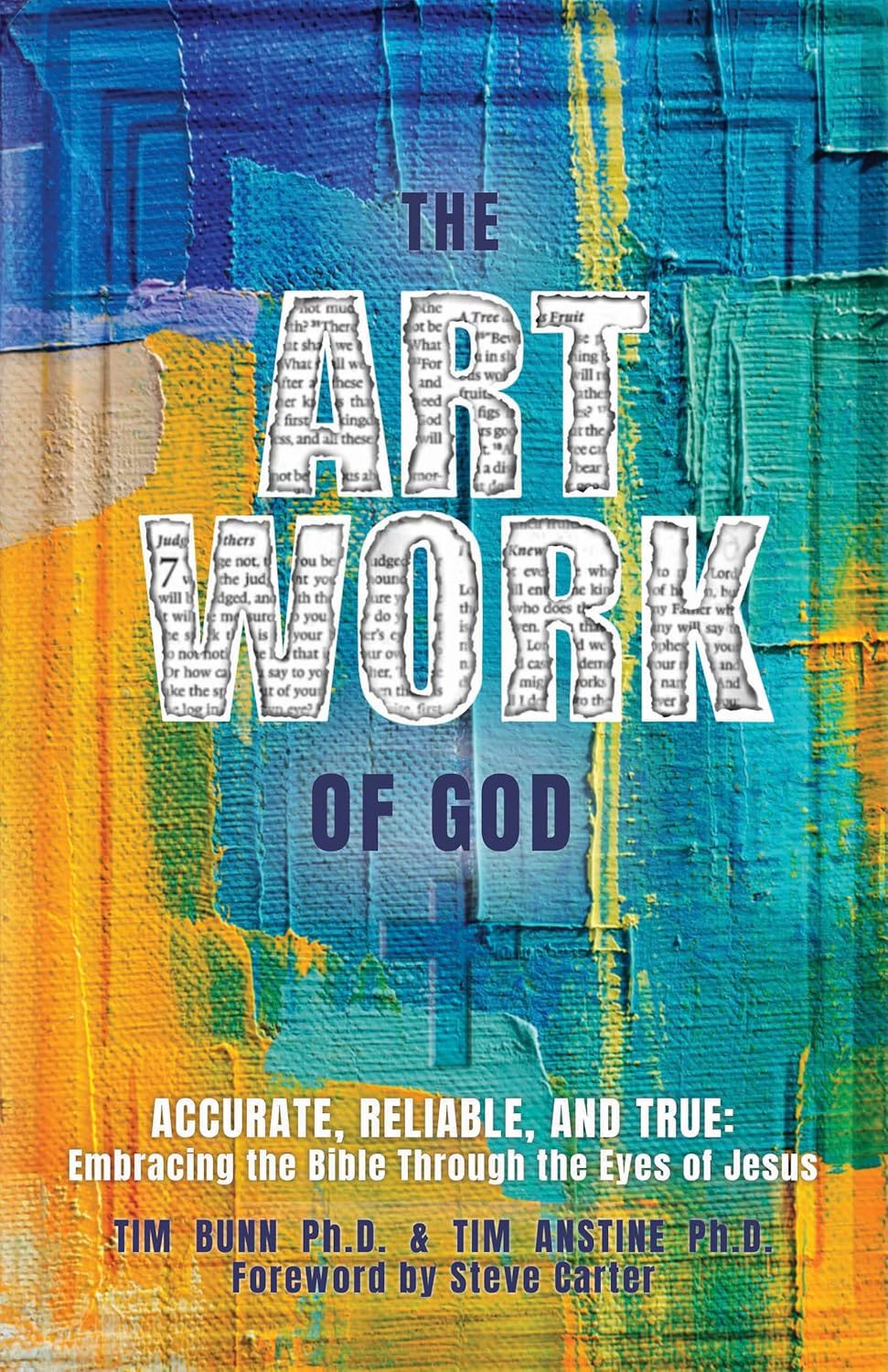
What happens when you mix up ideas like accuracy and literalism? Or, authority and inerrancy? You get The ARTwork of God (ARTwork). The core issue with this book is that it manages to conflate disparate ideas and be self contradictory. If I had to guess, I would say that the authors want to have their cake and eat it too. They want to embrace fundamentalism while staying within the doctrines of the denomination in which they are members (one being an ordained pastor). When I first saw a quote shared from this book on social media a wanted to find that it was out of context, so I purchased ARTwork to find out. I was very disappointed.
We can begin with the shared quote; “Many speak of Scripture as inerrant to all things necessary to salvation. The question we might do well to ponder is this: What is not necessary to our salvation journey when it comes to Scripture? We cannot compromise on the fact that God’s Word is accurate, reliable, and true.” (ARTwork p. 111) This statement is a recent favorite amongst clergy in the Church of the Nazarene (COTN) who would rather our doctrine of scripture shift to claiming textual inerrancy. I fully believe that the statement sets one up to be outside and teaching against the official doctrine of scripture of the COTN. Just for education, here’s a quick discussion of the article of faith on scripture within the COTN.
We believe in the plenary inspiration of the Holy Scriptures, by which we understand the 66 books of the Old and New Testaments, given by divine inspiration, inerrantly revealing the will of God concerning us in all things necessary to our salvation, so that whatever is not contained therein is not to be enjoined as an article of faith. (Manual)
First, the doctrine of the COTN makes no claim to the inerrancy of the text of scripture. Inerrantly in the article is an adverb describing the purpose of scripture to point to renewed relationship with God. Inerrantly does not describe the way we see the text, nor does it make any claim of historical, scientific, or other concerns. That is not the purpose of scripture. Second, it is ridiculous to make a claim that every word of scripture is profitable for salvation. This last point is where the authors may have read Richard S. Taylor more closely because Taylor is explicit that not every word of scripture reveals truth.
A third factor is that biblical authority must rest in a distinction between inspiration and revelation. Everything in the Bible is inspired, but not every verse in the Bible in and by itself reveals truth which is to be believed. In order to understand this, we must see clearly the distinction between inspiration and revelation, then the deduction which must be drawn from this distinction. (Taylor, loc 699)
But that is one of the great contradictions of this book. It makes arguments but misses the point of those from a Wesleyan-Holiness viewpoint. Maybe that is because many of the citations are from Reformed thinkers like Wayne Grudem, Ligonier Ministries, and Howard Lindsell. But the authors also cite N.T. Wright as a good resource for understanding the interpretation of scripture. This is a contradiction because Wright would disagree with the premise of the book as well as Grudem and Lindsell’s view of scripture. I believe Wright would be correct in doing so. Quite frankly, Nazarene scholar Paul M. Basset disagreed with Lindsell specifically on inerrancy. (Scripture study article)
Back to my first claim of mixed up ideas. The book contains a quote from a Gallup poll on the Bible in America. Here is the quote from the Gallup article. “The majority of Christians (58%) say the Bible is the inspired word of God but not everything in it is to be taken literally, while 25% say it should be interpreted literally and 16% say it is an ancient book of fables.” (Gallup) The fact is that the official doctrine of the COTN aligns with that 58% and always has. The authors point to this as proof of declining belief in the authority of scripture which leads me to believe they miss the point of authority. In the discussion of literalism, the authors conflate accurate and literal and then leap to authority. There also is an implication of truth and literal being the same thing. But this could be inadvertent because the authors are also not consistent with their demand that scripture must be literal. The truth is that no one is a true literalist. All interpreters choose what they want to be literal.
I happen to believe the Bible to be literally true. That doesn’t mean that I think I should pluck out my eye if I sin (Matthew 5:27-30) or that pillars hold up the Earth rather than the power of God (Psalms 75:3). I believe that Joshua prayed and the sun stood still. I believe that God spoke and the world existed in seven days. (ARTwork p. 113)
You see the problem? Interpretation is subjective, but Wesleyans believe it to be guided by the Spirit rather than the text. In chapter eight, the authors mention that science and the Bible can coexist. I agree with that, but based upon a later chapter, I suspect the argument is not the one made in chapter eight. I think the structure of the chapter may confuse the argument. I think they are being critical of the following quote from a Berkeley document, but it contains the more Wesleyan understanding
People of many different faiths and levels of scientific expertise see no contradiction at all between science and religion. Many simply acknowledge that the two institutions deal with different realms of human experience. Science investigates the natural world, while religion deals with the spiritual and supernatural—hence, the two can be complementary. Many religious organizations have issued statements declaring that there need not be any conflict between religious faith and the scientific perspective on evolution. (Berkeley)
The COTN has a statement on creation which does allow for scientific understanding. The issue happens when we start from scripture in order to understand science. The two have very different purposes. Modernism and fundamentalism attempt to force science and faith to be in conflict. This brings me to another issue. Chapter nine deals with the story of the flood. I get that many Christians see the Noah story as a factual history. But, science does not back that belief. This chapter relies on a single cited source which is not engaging in science. The source cited is a pseudoscientific supposition of what happened based upon a presupposed assumption of the flood story being true. The cited source is made up and not at all realistic. It sounds scientific to the layperson maybe, but it is not science. It is not peer reviewed and it is not a source that would be allowed in most educational environments. I am disappointed that a professor in a COTN institution would use such a poor source. But, that is the only way to try and prove the point.
Evangelicals have spent so much time trying to prove things of faith that we suck the meaning and beauty out of the stories. The truth of the flood exists whether it is factual or not. I wish the authors has spent some time in dialogue with the Wesleyan Theology Series book Creation by Eric Vail. That may have given context for this section. Belief in a literal seven day creation or a literal flood are not required for salvation. Understanding the truth that God is creator and what that means is. That’s what we should focus on as Christians, not descend into modernism’s arguments. This is where the grand conflict between someone like N.T. Wright and Ken Ham becomes a problem for the thesis of this book.
To see scripture through the eyes of Jesus means that some earlier texts have new meaning. This is another spot where the authors could have leaned on Richard S Taylor’s discussion of progressive revelation. Taylor argues that Jesus annulled portions of the Hebrew scriptures. Speaking of Jesus. The authors also make this statement. “When Jesus spoke about the prophets, He did so in such a manner that they were to be taken literally. He references Daniel, Job, Jonah, and Isaiah. He quotes them as real people; not as figurative characters of fable or metaphor.” (ARTwork p.60) Frankly we do not know this to be factual. The text does not reveal this so we make an assumption. If I preach, I may tell a story using Star Wars. I do not explicitly say these are fictional characters. We cannot make that leap with the words of Jesus either.
I don’t mean to pile on, but I would suggest you read several other books as this one does not add anything ans at best is a confusing incoherent argument in book form. The contradictions of the doctrine of scripture in the COTN versus the fundamentalist ideology of Grudem, et al and the good idea that we read scripture through Jesus but that somehow scripture is eternal is not worth your time. Scripture is finite, the Word of God as seen in the Logos, Jesus the Christ, is eternal.
For some better sources read Square Peg: Why Wesleyans Aren’t Fundamentalists, Richard Taylor’s Biblical Autority and Christian Faith, Stephen Green’s The Holy Scriptures, or you could read the linked report to the 2012 General Assembly by the committee recommending rejection of a change to textual inerrancy in the article of faith on Scripture in the COTN. These will give a far better understanding of scripture from a Wesleyan-Holiness viewpoint without an insistence on anachronistic inerrancy or literalism.
This book is arguing for a position outside of the official doctrines of the Church of the Nazarene. This is ironic given that promoters of the book have been involved in the removal of clergy credentials for elders arguing for change within published volumes. This book highlights a credibility gap in the application of Nazarene polity large enough to sail a container ship through. I gave the book two stars because I do believe we should read the bible through the lens of Jesus. However, the authors do not present that case, instead they read the bible through a modernist fundamentalist lens and force those “glasses” onto Jesus.
We need to quit spending so much time trying to prove things and start showing people who God really is. The who has always been the more important idea over the what. We really do waste time when we conflate accurate and true with inerrant.
Bunn Ph.D., Tim; Anstine Ph.D., Tim. The ARTwork of God: Accurate, Reliable, and True: Embracing the Bible Through the Eyes of Jesus
https://news.gallup.com/poll/394262/fewer-bible-literal-word-god.aspx
https://undsci.berkeley.edu/science-and-religion-reconcilable-differences/
https://didache.nazarene.org/index.php/filedownload/didache-volumes/vol-131/892-didache-v13n1-01-scripturestudycommitteereport-king1/file
Thanks for this book review! I've not yet read the book, but I've engaged with the authors for the last 20 years or so. Your worries about their views are the same as mine. They don't represent the best in Wesleyan/Nazarene thinking, and their views are inadequate overall. I appreciate voices like yours that provide a reasonable and biblically-plausible alternative! All Christians, but especially those in the Wesleyan traditions, need to reject biblical inerrancy and intelligent design. Doing so can lead to a BETTER and MORE authoritative view of scripture and MORE scientifically supported view. And doing so ENHANCES our awe of the art in creation.