


Video games have always had a story to tell. Even if that story is as simple as avoid the obstacles or “eat” the little dots. But even some early games told more complex stories. One of the earliest examples is the game Zork which was completely text based, but complex, funny, and told a story. Zork even had a “morality” program that would strike you dead for taking certain immoral actions. One of my personal favorites is Grand Theft Auto IV because your actions have consequences in the game world.
The stories in video games can be complex and contain social or cultural
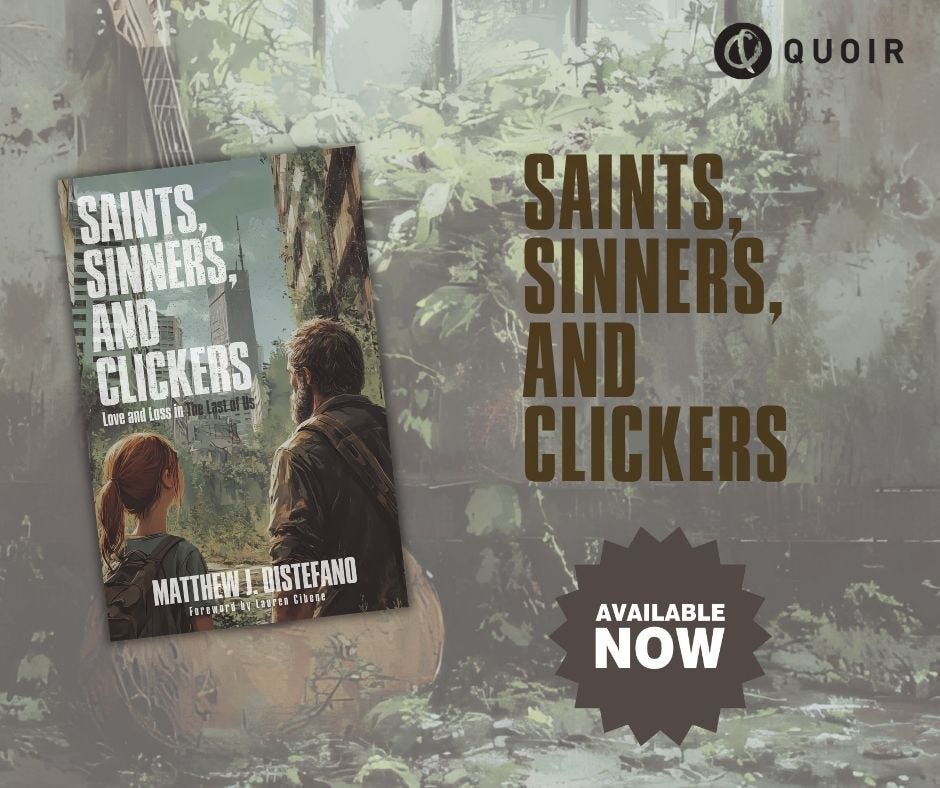
commentary. Such is the case with the game The Last of Us. Matthew Distefano delves into this commentary in his new book Saints, Sinners, and Clickers. My only experience with The Last of Us is the HBO television series because the game system I had when The Last of Us came out was an Xbox while The Last of Us is a Sony Playstation exclusive. But after reading Distefano’s book I wish I had played the games.
Early on Distefano comments on the reality of the game as apocalyptic fiction with no firm answers.
This reality forces me to ask: Why do we choose to play a game like this? Simple. Because, even though video games tend to transport us to a whole new world, some of the best represent real life. They represent the human experience.
He’s right about the fact that great games tend to represent the reaility of the human experience in all its messy and complicated reality. Apocalyptic literature is best when it is understood as “storytelling to use the end of the world, not to predict the future, but to hold a mirror to the present.” Because it is that mirror which can illuminate the truths we often do not wish to see. Especially when that mirror exposes our biases and the horrors we visit upon the world.
While The Last of Us does not have any mention of God or of rescue from the horror of mycelial “zombies” it does hold a mirror up to love. It is in love that Distefano connects the game world to our own. He faces the reality of human love and does not turn away. Love can be both healing and cataclismic. Distefano captures the full spectrum in his book. Even when considering choice, he is aware of the contradictions we all experience.
Nothing in life comes tabula rasa, and deep down, we know human beings are quite complicated. Every “choice” we make seems tied to a thousand invisible strings—trauma, love, fear, mimesis, survival, and so on. Freedom, then, if it exists at all, cannot simply be the ability to choose randomly (the way a cow “chooses” which patch of grass to chew6), but the ability to choose the good. The problem, most notably, is that the good is itself almost always muddy, hidden, or veiled in grief, trauma, and other baggage.
I can’t help but see hope even in hopelessness throughout the story of The Last of Us. Maybe it is the rumblimg optimism of Distefano in the face of fear and contradiction that gives me hope. But I agree with is assessment.
But whatever labels one puts on it, the idea is that true divinity is found in the God who doesn’t abandon the world—though it sometimes appears that way—but binds it together, cell by cell, root by root. In this sense, love itself is ecological. It spreads, roots, clings, regenerates, and in a world as dark as The Last of Us, constantly adapts.
The “God who doesn’t abandon the world—though it sometimes appears that way—but binds it together, cell by cell, root by root.” Distefano may not be Wesleyan, but this Wesleyan recognizes the God we claim to follow. It is in that I believe we find truth and hope. Distefano gets to a powerful realization from the game story.
The Last of Us shows us that love and loss cannot be disentangled, that to live is to lose, and that to lose is sometimes the only way we rediscover love again.
Love and loss can never truly be disentangled becuase when we love, we will inevitably experience loss. Rather than something to be avoided in fear, that reality makes our love burn brighter.
Get a copy of the book and experience a world of hope amidst pain and struggle. Even in the tragedies we will find love. I promise you’ll find truth in this book even if you know nothing about video games. mainly because human stories are universal stories for our species.