


The former Twitter has been buzzing this past week like in the “old days.” First is the wonder of a German tourist here for the World Cup. His description of the people, scenery, food, and quirkiness of the United States is a reminder of who we can be outside of polarized pressures upon us. But then there is the Japanese account @japan_nobunaga commenting upon shopping and food in a wondrously creative way. I almost cried at the description of biscuits and gravy.
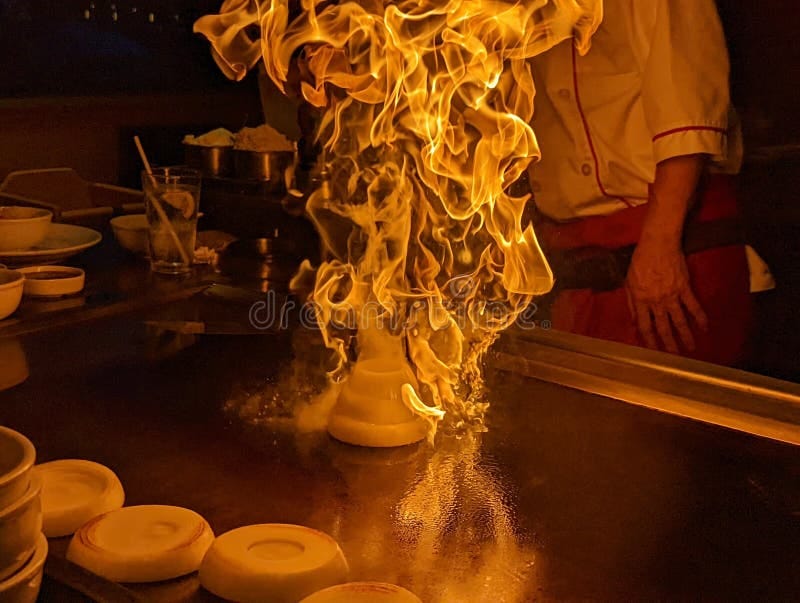
The most interesting to me was a visit to a Hibachi restaurant in which @japan_nobunaga’s friends thought they woudl experience a taste of home. You may see where this is going. Hibachi restaurants in the Unites States have little in common with Japanese cuisine or food traditions. That’s where this gets fun.
USA. A hibachi restaurant. My American friends brought me here to enjoy the cuisine of my homeland, and I witnessed a ritual I have never seen in eight hundred years of being Japanese.
The chef stacked onion rings into a tower. He filled it with oil. And he set it on fire.
“THE VOLCANO!” my friends cheered.
They knew the ritual.
They had seen it many times.
In Japan, I have eaten ten thousand meals.
No one has ever built me a volcano.
I said nothing.
A guest does not question the ceremony.
“Is this how they do it back home?” my friend asked, glowing with joy.
“...The technique is flawless,” I said.
A samurai may retreat. He may not lie.
He may, however, aim the truth very carefully.Then the chef flicked a shrimp through the air at my face.
“Catch it!” the table roared.
In my land, food is set before you with two hands and an apology for the wait.
Here, the shrimp attacks.
I caught it.
With my mouth.
The table erupted.
The chef saluted me with his spatula.
I have received medals with less pride.
“You’re a natural,” the chef said.
“My family has trained for this for generations,” I said.
It was not technically a lie.
We trained. Just not for this.
My friends drove me home, full and happy, honored to have shown me my own country.
A man does not question the volcano.
He catches the shrimp.
Whatever this cuisine is,
wherever it was truly born -- the fire is real, the joy is real,
and I caught what was thrown at me.
That is Japanese enough. (https://x.com/japan_nobunaga)
This is a perfect picture of how we can be gracious even when someone is completely getting our traditions, cuisine, liturgies, and culture totally wrong. I would say this is a good example of how we can be loving and compassionate when we interact with people we don’t see much in common with.
As I read the tweet, I thought of John Wesley’s catholic spirit idea. To Wesley, love and being followers of Jesus were much more important than getting everything exactly right or even perfect. Wesley has a lot to say about how we approach people different than we are.
“Every wise man, therefore, will allow others the same liberty of thinking which he desires they should allow him; and will no more insist on their embracing his opinions, than he would have them to insist on his embracing theirs.” (Wesley)
“I dare not, therefore, presume to impose my mode of worship on any other. I believe it is truly primitive and apostolical: but my belief is no rule for another.” (Wesley)
Or to be more clear about our own assumed beliefs.
“Yet can no man be assured that all his own opinions, taken together, are true. Nay, every thinking man is assured they are not, seeing humanum est errare et nescire: ‘To be ignorant of many things, and to mistake in some, is the necessary condition of humanity.’” (Wesley)
So even if we don’t want to give others the liberty to believe as they do, we need to be willing to understand that we may be wrong as well. To Wesley, the catholic spirit is one in which we might actually catch the shrimp tossed at us even if it is not what we expect in that context. How have we lost this grace?
Our Japanese friend shows us a better way of seeing one another and experiencing the different. The volcano and the flying shrimp are “opinions” and “modes of worship.” They are not wrong, just not how you do it at home. Wesley says you’re not required to adopt them, you’re not even required to be neutral about your own preferences, but you are required to catch what’s thrown at you with good humor and recognize the fire as real. The test isn’t “do you eat it my way?” but “is your heart right?”
Is your heart right? Discipleship isn’t about getting things right or perfect, it is about having a Jesus shaped heart. That requires trust of the Spirit within our differences. We seem to be so worried these days about what is right, accurate, or our way. So worried that we miss the beauty of difference and become afraid to embrace the different.
I wonder how the world would be different if we embraced the way of love rather than fear...
John Wesley, Sermon 39 “Catholic Spirit” (full text via Wesley Center Online)
This made me hungry for Hibachi and made me want to read Wesley all at the same time. Great article. When it comes to worship and discipleship I hope to catch the shrimp, clap for the volcano, and feel the heat of God's holy love. I appreicate you and your writing brother. You have a gift.