


My Christmas gift to you is the release of fear stoked by evangelical apologist influencers. I won’t try to convince you to simply quit listening to them, but I will tell you some truths about their ideology and how they become apologists for Empire and the powers. The latter is where fear and conspiracy enters the conversation the most. But apologists will attack any who ask questions that do not fit their neat little propositional understanding of Christianity. Most apologists, especially the influencers, are Reformed in theology, many have an understanding of sin which makes sin an ontological part of humanity’s being, and many have a view of God as controlling and loving only to a point.
I think one of the most egregious examples of the direction influencers are taking in Christianity is in the message Franklin Graham gave at a recent Department of Defense worship gathering. Graham made the claim that God is not only a God who loves, but a God who hates. While it is true that God hates sin; the contextual truth of that hate is centered in the harm of sin upon creation. Graham was clearly connecting the idea of God hating to the hatred of human beings. How do I know? By the very next statement Graham makes. “God is a god of war.” I realize that Graham and I have a very different hermeneutic, but I do not see the God of Abraham, Isaac, and Jacob; the God revealed through Jesus the Christ as a god of war. It appears that Franklin Graham is confusing the God of creation with Mars/Ares. That’s idolatry by the way. But how do we get to this point? How do we get to a moment in history when the son of a prominent evangelist becomes a messenger of the powerful? A few ways.
I’ll start with the way in which theologians seek to be clever. There is a trend among some to denigrate those with whom they disagree. Not content to simply disagree, they begin to traffic in fallacies of personality and make claims as to motivation not in evidence. I’ll start a bit close to home with Thomas McCall who teaches at Asbury. McCall is a Wesleyan, yet McCall feels the need to attack a person and even a place rather than engage fully with his disagreement. In doing this, McCall shows that he neither understands the subject matter, nor is he willing to actually engage on the merits. I’ll explain, but I think his attempt at cleverness and punching ends up doing two things. One, he looks silly and unserious. Two, he shows a lack of respectful dialogue (to be fair that is rampant in today’s evangelical spaces). It is the second point in which I believe our core issue lies. We no longer see one another as worthy of respect within disagreement.
In an essay entitled “’Amipotence’ is Not A ‘Solution’ to the Problem of Evil,” McCall is supposedly addressing disagreement with Thomas Jay Oord’s idea of Amipotence. Of course, as with many who address theologians such as Oord, McCall must be certain we understand other issues McCall has with Oord. Like our apologists, he attacks the person rather than engage the idea. I could go on about how McCall misses the point of amipotence and how he does not actually understand amipotence as a theological thought, but that’s for another essay. I will also say that McCall was invited to submit an essay to a large project on amipotence* in which essays that supported, critiqued, expanded, and applied amipotence appear but McCall did not respond.
Mccall first chooses to signal that he has disagreement with Oord on other ideas by trying to compare Oord as a person to McCall’s misunderstanding of amipotence by implying that it rejects an orthodoxy or trinitarian roots. McCall finds a way to denigrate both Tom Oord and the city of Nampa, Idaho while reminding us that Oord is queer affirming. This is a fallacy of genetics by the way. McCall is trying to use that fallacy without using it in his wider essay, but he reminds us through a childish statement. Tom Oord and I disagree on some things, but we can still be friends and have conversations in respect for one another. Here is McCall’s poor attempt at his fallacy:
Tom is contributor to an edited volume on sexuality, Tom is the editor of the same volume on sexuality, and Tom is head honcho of the small publishing company located in a ghost town in the desert of southwestern Idaho that publishes the same volume on sexuality... (McCall)
I suspect the human beings who inhabit Nampa would be surprised to find out they live in a ghost town. Shoot, the faculty and students of Northwest Nazarene Univeristy are probably shocked that they live in a ghost town. For fun, I asked Perplexity for the difference in population between Nampa, ID and Asbury, KY. The result is the same by using the incorporated town of Wilmore - see below.
The population difference between Nampa, Idaho, and Asbury, Kentucky, is substantial. Nampa, Idaho, has an estimated population of about 117,350 in 2025, making it a mid-sized city in Idaho. Asbury, Kentucky, is not an incorporated city but is best known for Asbury University, which has a total enrollment of approximately 2,086 students as of Fall 2024. If we consider the immediate area around Asbury, the population is generally counted as part of larger nearby towns, but there is no official city population for Asbury itself. (Perplexity AI)*
I hate to point out the obvious truth here, but will leave it up to you to see the great irony. The Amipotence project mentioned above contains several essays challenging the idea of Amipotence, but none of them choose to attack the origin. Instead, they respectfully address the idea and make cogent arguments without descending into sophomoric attacks.
Then McCall states that he cannot call the God described by Oord as the Lord as the description is so outside the bounds of orthodoxy, that Mccall is only able to label this God as The OORD. That is so very juvenile and not as clever as he thinks. I received some texts and messages when this volume of the Wesleyan Theological Journal was received in 2024 because of how poorly this reflected on the usual level of discourse in the Journal. But a few others think this is clever and they mention it. Andy Miller mentions this in a podcast discussion with Robert Gagnon concerning a book by Richard and Christopher Hayes. Miller, the President of Wesley Biblical Seminary (WBS) brings up McCall’s idea of the Oord and extends it to the Hayes.
As we walk the path of how we get to evangelicals calling God a god of hate and war, it helps to understand a feature of modern evangelicalism. The emerging unifying idea within the majority of white evangelicalism is an understanding of human sexuality mixed with American Right-Wing Politics. In that context, it seems that almost all other doctrines are secondary.
Robert Gagnon is a good example of the direction apologists are taking in our contemporary moment. Gagnon’s specialty is human sexuality from the traditional view. He is considered the leading scholar in this area by traditionalists. He does focus on this area and that is his connection to WBS and other institutions and groups. But he is primarily a Reformed and complentarian thinker. His underlying arguments lean heavily on the idea that gender roles and norms are prescriptive. This is in contrast to the majority of Wesleyan scholarship in which equality is at the forefront. But Gagnon has what appears to be another interest in supporting Donald Trump and making apologetical arguments for actions and policies. If you take a scroll through Gagnon’s X thread, it is essentially his ideas on sexuality, demands that Christians support Donald Trump, and unending reshares of right-wing influencers. It also appears that Gagnon’s ethics and morality are deeply influenced by politics rather than Jesus.
I have said it before, but let me be clear. It is wrong for a Christian to say that Christians must vote for a certain person or a certain party or you are not “Christian enough.” It is always wrong. Yes, we can say that voting for certain things should be avoided, but claiming that Christians can only vote for a particular candidate is wrong. Gagnon explicitly claims that if Christians did not vote for or support Donald Trump, they are not being faithful. What a load of partisan crap. Here’s some context in an interaction I had with Gagnon. On X Gagnon commented that anyone who believed that Charlie Kirk deserved to die should be removed from society.
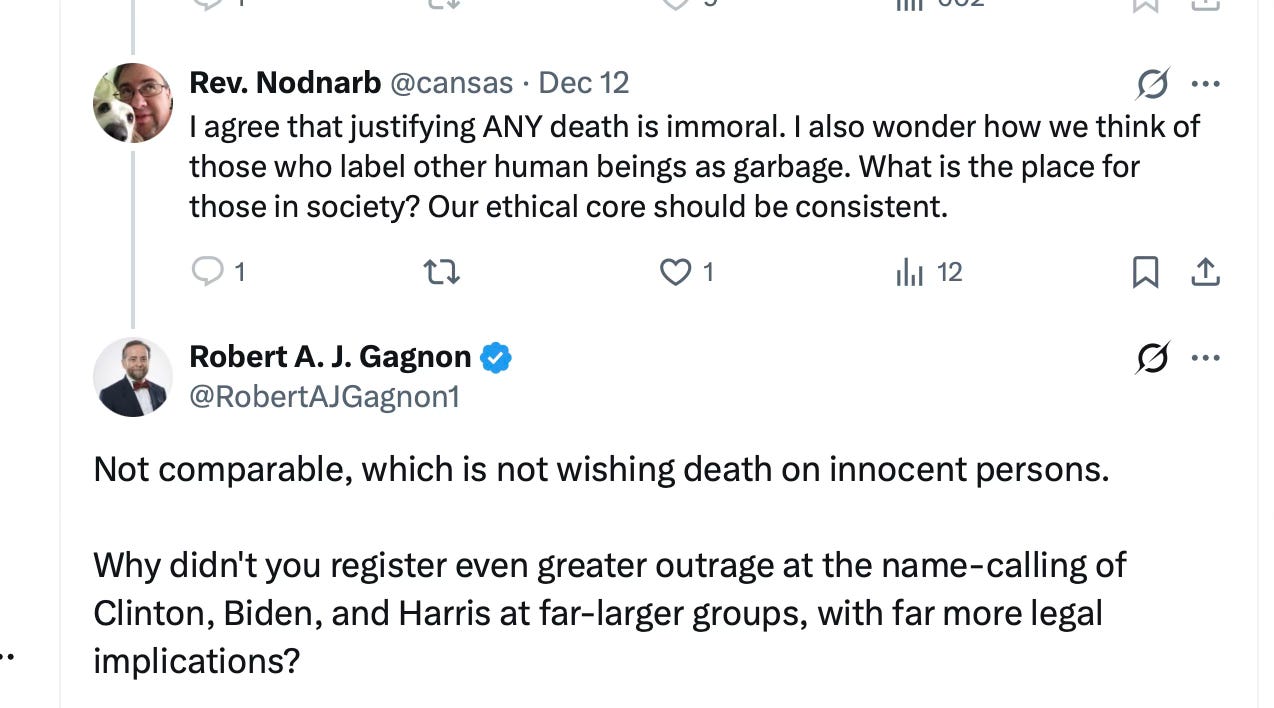
I agree that it is wrong to wish for the death of anyone. But I also believe that it is wrong to dehumanize human beings. So I asked Gagnon how we should think about calling human beings garbage. To be clear, I had the many examples of politicians in each party using such language in my mind. I assumed that Gagnon would engage the question and the idea. I was sorely disappointed. Instead of engaging the idea directly, Gagnon responded with a copy and pasted wall of unrelated text and blocked me. That is both lazy and ridiculous. I’ll post a screenshot below, but here is what he replied to my question about calling human beings garbage. Gagnon has no idea who I am so I wonder how he came to his conclusions?
“Not comparable, which is not wishing death on innocent persons.
Why didn’t you register even greater outrage at the name-calling of Clinton, Biden, and Harris at far-larger groups, with far more legal implications?
In Oct. 2024, after there had already been two assassination attempts against Trump, Kamala Harris called Donald Trump a “fascist” and likened his agenda to Nazi Germany. What does that make those voting for him?
In July 2024 Harris characterized as “these extremists ... they not like us” those who oppose “the freedom to love whom you love” (that is, those who oppose the immorality of “gay marriage” and transgenderism) and “the freedom of a woman to make decisions about her own body” (that is, to kill her child in the womb). What kind of faithful Christians would vote for a candidate who had publicly declared them to be “extremist,” and plans to treat them in the law accordingly by impinging on free speech and the free exercise of religion (the true fundamental freedoms)?
A year ago Biden called Trump supporters “garbage.” That’s half the nation. In 2018 at the so-called “Human Rights Campaign,” the most powerful transgender-gay lobby in the nation, Biden declared that if you oppose the so-called “Equality Act” and other coercive trans/gay legislation (including chemical castration of minors) you are the “forces of intolerance,” “virulent people,” and “the dregs of society.”
In the 2016 campaign Hillary Clinton called “half” of Donald Trump’s supporters a “basket of deplorables” because of their alleged “racist, sexist, homophobic, xenophobic, Islamaphobic” views and “offensive, hateful rhetoric,” folk “irredeemable and not American.”
How could any Christian vote for a candidate who believed this about his or her children, and wants to inscribe this view in the law, simply because you and your children share Jesus’ conviction about a male-female foundation for marriage and the integrity of one’s birth sex? But many “Christian” leaders, including “elite” Evangelicals,” advocated for just that. What kind of Christian votes for a candidate that wants to inscribe in law that your children are hateful, ignorant bigots?
As you mama told you, “two wrongs don’t make a right.” My point is that the name-calling engaged in by Trump and by his Democrat opponents at best cancels out and at worse is far more ominous on the lips of the Democrat candidate so far as Christians are concerned.
So switch to considering whose policies, executive orders, and court appointments are going to do the least harm and the most good.
When some Evangelicals and conservative Catholics use Trump’s name-calling of others (which is, btw, usually distorted in the retelling) as a basis for railing against Christians who voted for Trump, my first reaction is: What an incredibly shallow justification for failing to cast an effective vote against (or even for voting for) the hard-left Democrat option that is promoting ...
--chemical castration of minors, males in female private spaces and sports, compelled trans speech, forced indoctrination of children into LGBTQ immorality, unrestricted abortion, persecution of pro-life protestors and crisis-pregnancy centers, the appointment of hard-left judges to the highest courts of the land, the massive unvetted illegal-immigration election fraud, Banana-Republic lawfare against political opponents, speaking out against the free speech and free exercise of religion of conservatives, and ... well, don’t get me started.
To such persons I say: Grow up and get a mature sense of the magnitude of what is truly dangerous for the country long-term.” (Gagnon copy and paste to me)
I began a response which asked what that had to do with anything. But I also wrote a response to the very first sentence which is the only relevant thing Gagnon wrote. I wrote that Jesus told his disciples that holding hate in the heart is like murder. To Jesus, hating others, dehumanizing others, and such is just plain wrong. To Jesus, calling people garbage and wishing people dead is an apt comparison.
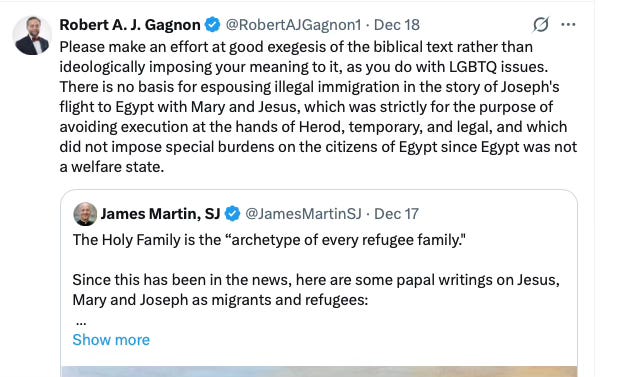
But then Gagnon seems to struggle with words and exegesis based upon this X post. Thinking refugee means illegal immigrant is quite frankly a position based in ignorance (the post he is responding to only deals with the idea of refugee). It is also a position taken based upon political discipleship. But can you see how a shift from ignoring the fact that Jesus believed hate to be like murder can lead to calling God a God of hate and war?
The apologetics influencers have become apologists of empire. Alisa Childers, Frank Turek, and Robert Gagnon are examples of those who say they are apologists for God who take a hard turn to politics and demand that Christians believe like they do. When the postmortem on American evangelicalism is written, it will feature heavy doses of hatred, name calling, and sophomoric claims.
Just to highlight the way that Christian influencers spread falsehoods, here is an example. Several Christian influencers all posted a similar post within an hour period.
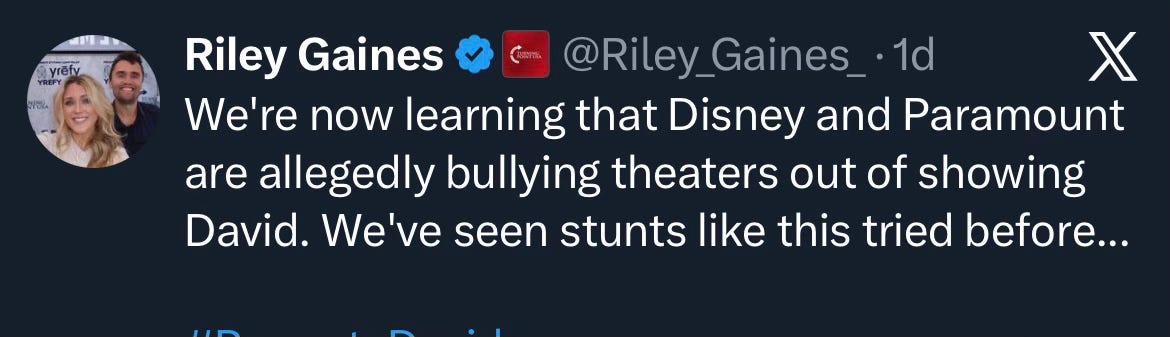
The truth is that the claim made in these posts is not true. Disney and Paramount were not involved in any bullying, nor would they be. Both studios have popular movies in theaters and they are not afraid of Angel Studios. This is a marketing ploy that Angel has used in the past. When Angel had exclusive streaming rights to the Chosen series, they used marketing materials which claimed that no major streaming service would stream the Chosen. Of course not, because Angel held the exclusive rights outside of the Chosen app. When those rights expired, Amazon snagged the Chosen. Angel was claiming huge enthusiasm from theaters for David even as the influencers were peddling their conspiracy marketing.
Influencers spread falsehoods using hedged language like allegedly or heard reports, etc. But these are still falsehoods. The influencers may be duped, but they may also be paid for these marketing shares. The use of fear, supposed conspiracy, and pretend persecution is an onerous way to spread influence. It is also not something Christians should pursue.
I feel we really need to start taking faith seriously. The apologist influencers do no such thing. In fact, you are free to ignore them as they often use false claims, misunderstand the subject, or present very narrow understanding of Christianity. In fact, the bulk of apologist influencers make claims that would put Wesleyan-Holiness folk outside of the apologetical understanding of Christianity. Discipleship is hard, influence is easy and profitable. It is easy to stoke fear and outrage, but incredibly hard to engage in respectful disagreement. At least in our current cultural reality.
Craig Hovey speaks to the problem with looking to things outside of Christ for salvation or help. “Insofar as the church contents itself with the reduced horizons and abortive expectations necessary to hope in the salvation of the nations by their leaders, it has already chosen its kings.” (Craig Hovey, To Share in the Body: A Theology of Martyrdom for Today’s Church)
For disclosure, I was the lead editor of the editorial team for this project on amipotence
https://wbs.edu
McCall, Thomas. “‘Amipotence’ is Not a ‘Solution’ to The Problem of Evil: A Response to Thomas Jay Oord” Wesleyan Theological Journal 59, no. 1 (Spring 2024): pp 31-42.
If we compare the incorporated town of Wilmore, KY it is similar.
Nampa PopulationNampa’s 2025 estimated population ranges from 117,350 to 119,931. This reflects steady growth at about 2.2% annually.
Wilmore, a small city in Jessamine County, has a 2025 population of around 6,268 to 6,436. Growth occurs at 1.04% to 2.7% per year, influenced by Asbury University.