


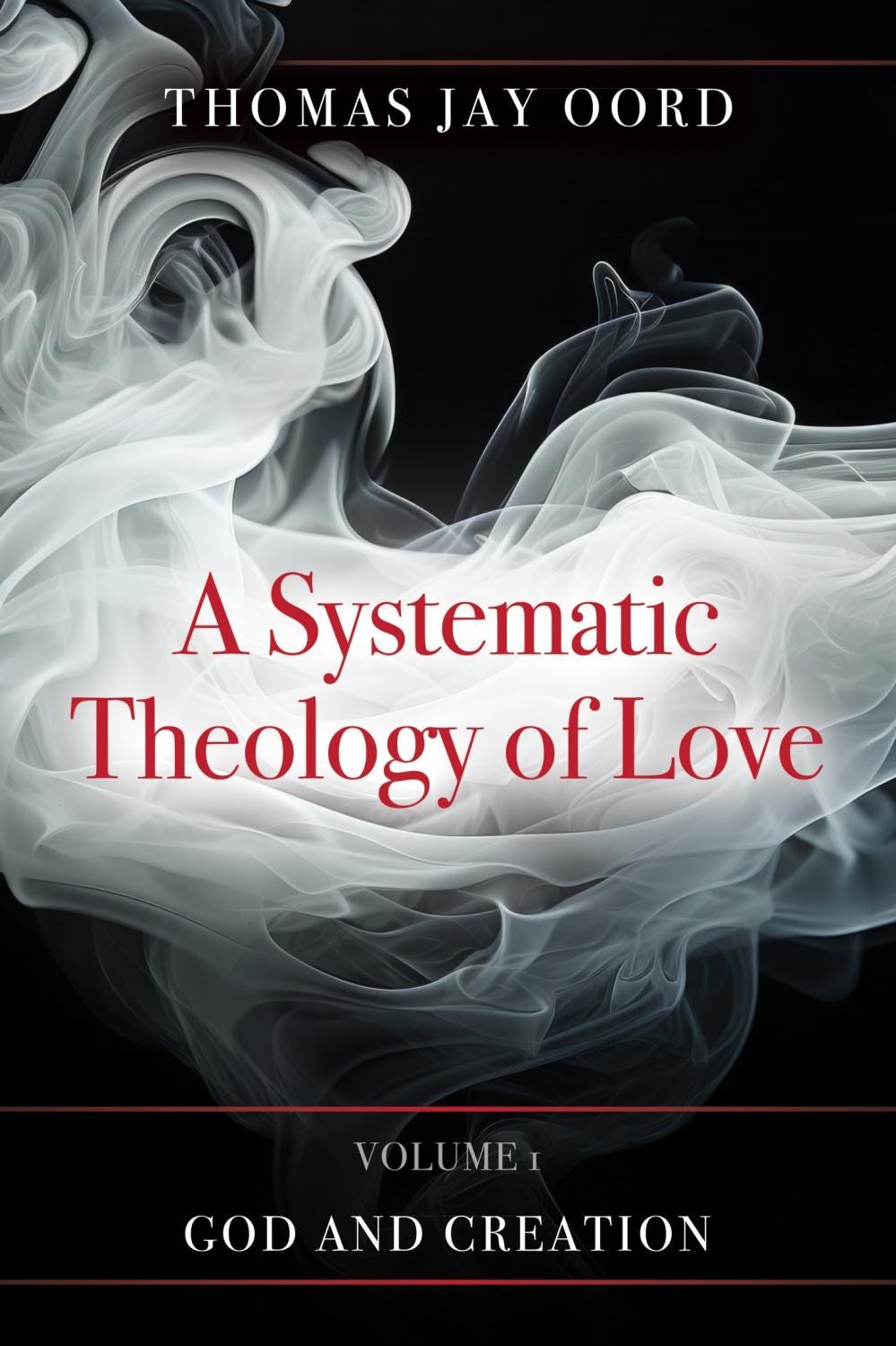
Writing theology is a ambitious task in and of itself. But embarking on a systematic theology is daunting, but that is just what Dr. Thomas Jay Oord is doing. His A Systematic Theology of Love is a planned multi-volume work. Volume One is currently available and its subtitle hints at the contents: God and Creation. Most systematic theologies currently available are within the Reformed or Calvinist tradition. In fact, one of the best selling systematic theologies is Wayne Grudem’s Systematic Theology is the top seller in systematic theologies. This may be partly because it is the default for Southern Baptists who are currently the largest Protestant denomination in the United States. Worldwide, things are different, but you get the picture. Of course, popularity does not indicate the value of a work. This is especially true in theological works. Something can be very popular, but also very bad. Thinking in terms of Wesleyan-Holiness theologies, systematic works are few and far between. I believe this is partly due to the nature of Wesleyan theology being seen as practical and Holiness theology as primarily revivalist in nature. But these are stereotypes and stereotypes have a way of falling apart upon close examination.
Oord’s Systematic THeology of Love builds upon Wesleyan-Holiness, Open and Relational, and Process theological work. I can see the foundation of Dr. Mildred Bangs Wynkoop’s book A Theology of Love, H. Ray Dunning’s Grace, Faith, and Holiness: A Weslyean Systematic Theology, and other works within Oord’s own theological heritage. Of course, this work expands and goes beyond those earlier works, but you may be able to take the person out of a particular Wesleyan-Holiness denomination, but you cannot take the Wesleyan-Holiness theology out of the person.
It is important that Oord begins with God and Creation, because those are the building blocks of a solid and faithful systematic theology. But volume one also deals with the definition of love which Oord honed in Pluriform Love. Oord also takes a tact very different from many theologians by using the humility we all so desperately need by saying that “I could be wrong about all of this, of course.” (Oord) In a world in which being right is often seen as the attitude we should hold, Oord’s admission is key to understanding the spirit in which his systematic theology is born.
From and Open and Relational view, starting with God is key to understanding both the open and relational aspects of who we claim God to be. Oord’s previous works on love, amipotence,* and the nature of God as uncontrolling love features throughout. But Oord builds upon those ideas to form them into a systematic investigation into God. From the who, to the place of mystery, Oord weaves a cogent argument for who he claims God to be. I firmly believe that Oord is expressing the logical progression of Wesleyan and Holiness theologies of God within his discussion of God. Contrary to critics, the God revealed in Oord’s work sounds very much like the image we are given in the Christian scriptures.
The second building block of volume one is Creation. Oord’s discussions center upon God as always creating which I find compelling. But Oord also shows the flaws with ideas like creatio ex nihilo (creation from nothing). Scripture does not support the idea of creatio ex nihilo if wee read closely. Oord points out that creatio ex nihilo was originally a gnostic creation. God could not start with a corrupted thing like matter after all. Oord’s direction also embraces recent advances in science and our understanding of the universe. While I am partial to the idea of multiverse, Oord describes what I term a sequential-verse. God is always creating and that even means creating out of the death of universe upon universe.
Additionally, Oord explains that God invites us to participate in creation. This is where an Open and Relational theology truly comes into its own. We are invited to participate and work in creation. I see this as the ultimate and over arching tending of the garden. The very thing humans are first invited to do with God was tend a garden in the Genesis accounts of creation. Oord sums up concerns with creation in this way:
Science can’t, on its own, answer the question of why there is something rather than nothing. But theology also can’t answer this question alone.105 The most plausible doctrines of creation, therefore, integrate insights from science, theology, and metaphysics. Or as Alfred North Whitehead put it, “You can’t shelter theology from science, or science from theology; nor can you shelter either of them from metaphysics, or metaphysics from either of them. There is no short cut to truth.” (Oord)
Rather than try and create conflict with science, or worse twist science to prove a theological assumption, Oord embraces science while understanding its limits. He also understands the limits of theology within his humble take on possibly being wrong. For me, any time a theologian writes or says out loud the truth that we could be getting this wrong, I tend to listen more carefully. Those theologians who know they could be wrong are ones worth listening to because they approach theology with that truth.
Oord’s A Systematic Theology of Love belongs in any serious theologian’s library. Especially if you disagree with the conclusions. Because what if you are wrong?
Disclosure
I am a supporter of Tom’s work on his systematic theology and have been able to read early work and give feedback as he wrote. While I received a complementary copy of teh book, I also purchased a copy.